%20--%3e%3cdefs%3e%3cstyle%3e%20.st0%20{%20fill:%20%23061b40;%20}%20.st1%20{%20fill:%20%23306af1;%20}%20.st2%20{%20fill:%20%235ce5cf;%20}%20%3c/style%3e%3c/defs%3e%3cg%3e%3cpath%20class='st0'%20d='M55,10.5h9v3h-9v9h12V7.5h-12v3ZM64,19.5h-6v-3h6v3Z'/%3e%3cpolygon%20class='st0'%20points='69%2016.5%2078%2016.5%2078%2019.5%2069%2019.5%2069%2022.5%2081%2022.5%2081%2013.5%2072%2013.5%2072%2010.5%2081%2010.5%2081%207.5%2069%207.5%2069%2016.5'/%3e%3cpolygon%20class='st0'%20points='95%2010.5%2095%207.5%2083%207.5%2083%2022.5%2095%2022.5%2095%2019.5%2086%2019.5%2086%2016.5%2095%2016.5%2095%2013.5%2086%2013.5%2086%2010.5%2095%2010.5'/%3e%3cpath%20class='st0'%20d='M40,1.5v21h11.6l1.4-1.4v-7.6h0c0,0-1.4-1.5-1.4-1.5l1.4-1.4V2.9l-1.4-1.4h-11.6ZM50,19.5h-7v-6h7v6ZM50,10.5h-7v-6h7v6Z'/%3e%3c/g%3e%3cpath%20class='st1'%20d='M23.1,24L14.7,4.8l-4.9,11.2h3.8l-1.8,4H3.3L12.1,0H2C.9,0,0,.9,0,2v20c0,1.1.9,2,2,2h21.1Z'/%3e%3cpath%20class='st2'%20d='M34,0h-16.8l10.6,24h6.2c1.1,0,2-.9,2-2V2C36,.9,35.1,0,34,0ZM32.5,20h-4V4h4v16Z'/%3e%3c/svg%3e)
 Join Now
Recently, OpenRouter released a groundbreaking study that analyzed the usage of large language models (LLMs) across different tasks, regions, and time periods, based on over 100 trillion real-world token usages collected on its platform. The study shows that since the launch of the first widely adopted reasoning model o1 in December 2024, there has been a significant shift in how LLMs are used.
The study points out that the use of open-weight models has seen a significant increase, especially in areas such as creative role-playing and programming assistance, exceeding expectations that focused mainly on productivity tasks. Additionally, the study found that early users have significantly higher engagement than later users, a phenomenon known as the "Cinderella's Glass Slipper Effect," highlighting the importance of early alignment between user needs and model characteristics in maintaining user retention.
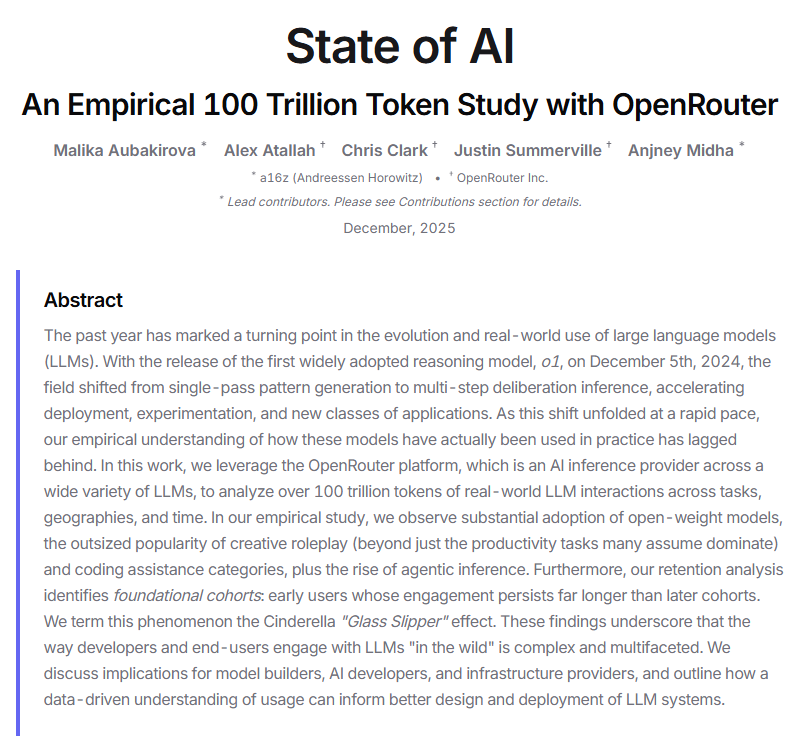
Through in-depth analysis of the data, the research team revealed various usage patterns, including trends in the use of open-source versus closed-source models, global usage differences, and relationships with price and new model releases. This empirical study fills a knowledge gap regarding LLM usage, emphasizing the diverse ways in which developers and users interact in practical applications.
The study utilized data from the OpenRouter platform, offering a unique perspective on how these models are used, aiming to provide data support for future model design and deployment. The analysis also covered how users choose models in different regions and the reasons for maintaining long-term usage.
Report: https://openrouter.ai/state-of-ai
Key Points:
🌍 Analysis of global usage patterns reveals differences in demand for LLMs across regions.
📈 Rapid growth in the use of open-weight models, especially in creative and programming fields.
🧩 The "Cinderella's Glass Slipper Effect" indicates that the compatibility between early users and models is crucial for long-term engagement.